Our Favorite Non-Toxic Household Products
Over the last few months, some of our customers have asked what products we actually use inside our own house. Here is a look at the staples currently in our cabinets and why we chose them. By the way, NONE of these are sponsored by anyone, just tried and tested by us.
Non-Toxic Cooking
You might already be focused on buying organic foods, but the surfaces that come into contact with your food are important, too. Most traditional non-stick pans rely on a coating made from PTFE (polytetrafluoroethylene, aka Teflon), which is a type of PFAS. These are often called "forever chemicals" because their molecular bonds are so strong that they never fully degrade.
When you cook with these pans, especially if they are scratched or overheated, these chemicals can migrate directly into your food and eventually into your bloodstream. Exposure to PFAS has been linked to a long list of health issues, including hormone disruption, thyroid disease, and even certain cancers. A fantastic movie on this topic is Dark Waters, which I highly recommend watching if you want to see the real-world impact of these chemicals.
Why "Ceramic" Isn't Always the Answer
Many "green" pans marketed today claim to be PFOA-free or PFAS-free, but they often replace one chemical with another similar version that just hasn't been regulated yet. Furthermore, most ceramic-coated pans—like the ones from Caraway or Our Place—are actually a "sol-gel" coating. This is essentially a silica-based spray that mimics the look of ceramic but is applied over an aluminum or copper core.
These coatings are notorious for losing their non-stick properties quickly. Once that thin layer chips or scratches, you are exposing the metal underneath. A damaged coating allows aluminum to leach directly into your food, defeating the entire purpose of buying a "non-toxic" pan in the first place. Aluminum is a neurotoxin that can accumulate in your brain and soft tissues over time, where it is linked to oxidative stress and long-term cognitive decline.
If you want the benefits of ceramic without the hidden coatings or metal cores, look for a brand like Xtrema. They are one of the only companies making 100% solid ceramic cookware. There is no aluminum center and no synthetic glaze; it is essentially a high-tech version of the ancient clay pots humans have used for thousands of years.
Go For Stainless Steel
If you want a pan that lasts a lifetime without chemical leaching, high-quality stainless steel is the gold standard. You can verify the quality of your cookware by using a simple magnet. Hold a magnet to the bottom of your pan. If the magnet creates a strong, firm snap against the metal, the pan contains enough magnetic grade steel to be durable and heat-efficient. If the pull is weak or nonexistent, the metal is likely a cheaper, less stable alloy. We made the switch to All-Clad stainless steel pans because the material is incredibly durable and does not leach chemicals into your food.
Cooking Tricks for Stainless Steel and Ceramic
Both stainless steel and ceramic require a bit of a strategy to prevent food from sticking. Use a fat with a higher smoking point, like grass-fed butter, ghee, tallow, coconut oil, or avocado oil. We could write a whole other blog about the health disadvantages of seed oils like canola, soybean, and sunflower, but we’ll leave that discussion for another day.
The trick is to let the pan heat up first and test the temperature by adding a drop of water on the pan. If the droplet of water forms a pearl that slides across the surface, the pan is ready. Add your fat next, and wait for it to shimmer or for the butter to bubble slightly before adding your food.
Avoid Plastic
Plastic is one of the most ubiquitous sources of our daily exposure to toxins. Just yesterday, we were sitting in a cafe (Paul and Jack’s in Wake Forest, which I highly recommend) when a little girl at the table next to us told her mom she couldn't use the plastic spoon in her hot chocolate because she’d get microplastics. What a smart cookie!
What Are Microplastics?
Microplastics are tiny plastic fragments, often smaller than a grain of sand, that shed from synthetic materials through heat or friction. Because these particles are so pervasive, they have been found in human blood, lung tissue, and even the placenta. Recent studies suggest that the average person may ingest a credit card's worth of plastic every single week.
Once inside the body, these particles can cause physical irritation to tissues and act as "Trojan horses" for harmful chemicals. They often carry heavy metals and endocrine disruptors that interfere with our natural hormone signaling. Read more about endocrin disruptors in our blog Lawn Pesticides and Infertility. While the long-term data is still emerging, researchers are investigating links between microplastic accumulation and increased inflammation, oxidative stress, and metabolic disorders.
Wood and Glass to the Rescue
Plastic cutting boards are definitely a culprit for microplastic ingestion. Every slice of a knife carves tiny, invisible plastic shards into your ingredients. We swapped plastic cutting boards for solid wood ones. Wood is naturally antimicrobial and won't add synthetic fibers to your salad. Using a wooden board protects your knives and keeps plastic out of your bloodstream.
We also replaced our plastic storage containers with glass. Heating plastic, even just putting warm food inside, causes it to leach endocrine-disrupting phthalates and BPA into your leftovers. Glass is safer for your hormones and won't absorb food odors or stains.
And for the love of all that is holy, stop drinking out of plastic water bottles. Get a refillable, plastic-free bottle like Owala and filter your water with ZeroWater pitcher or something better than Brita that actually removes toxins like fluoride.
Clean Up Your Laundry
One of the most worst substances inside your home is a chemical called 1,4-dioxane. While it’s found in your typical container of Gain or Tide, it won’t be listed on their product label because it is not an intentional ingredient. Instead, it is a byproduct created during a manufacturing process called ethoxylation. Companies use this process to turn harsh chemicals into the sudsy, soft detergents consumers expect.
The EPA classifies 1,4-dioxane as a probable human carcinogen. It is linked to liver and kidney damage, and it is incredibly persistent. It does not break down easily in the environment, meaning it stays in the water, the soil, and eventually your body. In fact, New York recently moved to ban detergents containing high levels of this byproduct because it is nearly impossible for public water systems to filter it out.
Since 1,4-dioxane is hidden, you have to look for the ingredients that signal its presence. Go grab your current detergent (and for that matter, any personal care products) and look for these specific red flags on the back of the bottle:
- Sodium Laureth Sulfate (SLES)
- Polyethylene Glycol (PEG)
- Ingredients ending in "-eth" (like Ceteareth or Laureth-6/7)
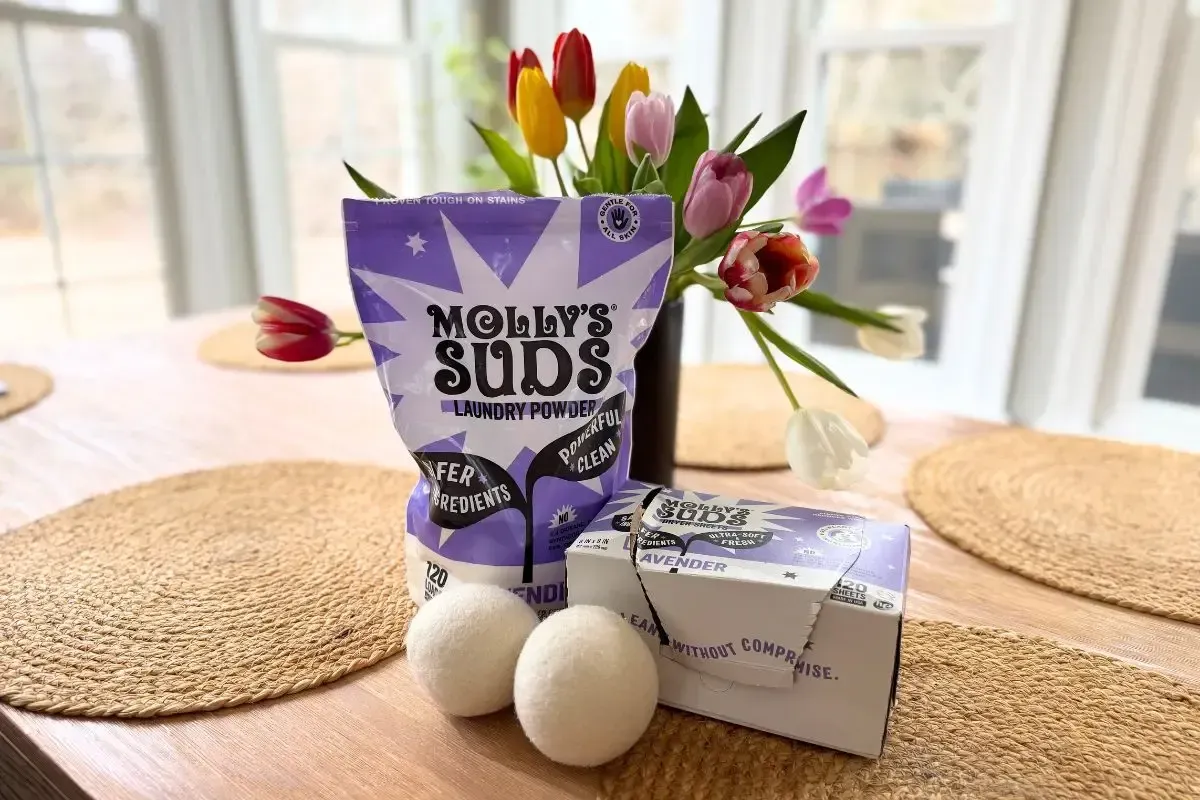
We use Molly’s Suds because they skip the ethoxylation process entirely. Their formula relies on simple, mineral-based ingredients that clean your clothes without leaving behind a trail of carcinogenic byproducts. Their lavender detergent smells heavenly, and we pair it with their dryer sheets and wool balls for fresh, safe loads. Some people add essential oils to their dryer balls, but I’ve found that it leaves oil stains on my clothes.
Ditching Toxic Dishes
Standard dishwasher detergents frequently contain phosphates and chlorine bleach. While phosphates are effective at breaking down food, they are environmental disasters. When they wash out of your machine, they end up in our local North Carolina waterways, fueling massive algae blooms that choke out oxygen and kill off fish populations.
Even more concerning for your immediate health are the ethoxylated surfactants. These surfactants are often contaminated with 1,4-dioxane. Because the dishwasher uses high heat and steam, these volatile organic compounds (VOCs) are released into the air of your kitchen while the machine runs. You aren't just eating these chemicals; you are breathing them in.
Most people use a rinse aid to prevent water spots, but conventional versions are some of the most chemically intense products in the kitchen. They often contain methylisothiazolinone, a potent preservative linked to lung toxicity and severe skin allergies. Since the rinse aid is applied during the very last cycle, it is designed to stay on the dishes to help them dry. As a result, you are essentially eating off a thin film of preservatives every time you set the table.
A Cleaner Way to Wash Dishes
We transitioned to Blueland dish tablets to avoid the toxic chemicals and microplastics in typical dishwasher pods. These are "naked" tablets, meaning they eliminate the polyvinyl alcohol (PVA) plastic film entirely. More importantly, the formula is free from dyes, synthetic fragrances, and chlorine bleach. You get the mechanical cleaning power you need without the lingering chemical film.
To keep our glasses clear without the toxic hitchhikers, we pair those tablets with Ecos Rinse Aid. Instead of harsh synthetic solvents, it uses plant-derived surfactants to break the surface tension of water, so dishes come out spot-free while keeping your hormone health intact.
All-Purpose Cleaner
Most recently I used Ever Spring lavender & bergamot all-purpose cleaner from Target. It’s marketed as a "cleaner" choice, and the packaging looks great, but once I took a closer look at the label, I realized it still contains that vague "fragrance" ingredient. That one word can hide hundreds of untested chemicals and phthalates.
On my next Target trip, I plan to grab the Branch Basics
all-purpose cleaner. Branch Basics has an impeccable reputation in the non-toxic community for being completely transparent about every single ingredient. Plus, it’s now available at Target, making it just as convenient as the "green-washed" brands.
If you want the most budget-friendly option, a simple mixture of white vinegar and water is as non-toxic as it gets. Vinegar is a natural acetic acid that handles grease and most household bacteria. To be honest, I don't love this method as much because of the smell. While the "salad dressing" aroma does dissipate once it dries, it can be a bit overwhelming while you are actually cleaning. If you go this route, you can add a few drops of organic lemon or peppermint essential oil to help mask the sharp scent.
Detoxing Your Home
Focusing on these details might feel overwhelming at first, but the goal is simply to reduce the total toxic burden on your body. While pesticides applied on your lawn and in your home are probably the most toxic products you come in contact with, the multitude of products you use inside your home do add up over time.
If you’re not up to overhauling your life all at once, begin by replacing traditional products for more non-toxic versions as you run out. Every little step in the right direction helps, and before you know it, you’ve arrived at a much safer environment for your home.
If you have not yet ditched toxic pesticides in your lawn care and pest control, sign up for our organic services online in the Raleigh-Durham, NC area.